


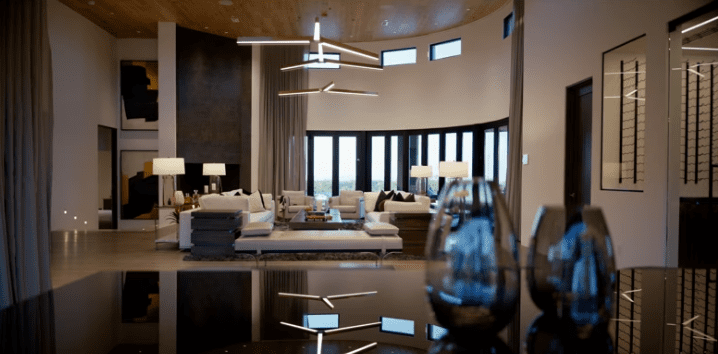
In the unforgiving embrace of Arizona’s Sonoran Desert, where temperatures soar past 110 degrees Fahrenheit and relentless winds sculpt the landscape, true luxury resides not in defiance of nature but in masterful harmony with it. For discerning homeowners and designers, crafting desert home interiors that exude sophistication requires more than aesthetics; it demands precision-engineered strategies that transform arid challenges into opulent sanctuaries.
This analysis delves into the art and science of desert home interiors, tailored specifically for Arizona’s luxury market. We examine resilient material selections, from rammed earth walls clad in polished travertine to UV-resistant textiles that maintain vibrancy under brutal sunlight. Cooling innovations, such as passive solar shading and evaporative systems integrated seamlessly into modernist architectures, take center stage alongside color palettes that draw from ochre dunes and twilight skies for visual depth and thermal equilibrium.
Advanced readers will gain actionable insights: biomechanical ventilation models, sustainable sourcing from local quarries, and spatial configurations that maximize views while minimizing heat gain. Through case studies of iconic Scottsdale estates and Phoenix retreats, discover how elite architects balance indulgence with endurance, elevating desert home interiors to unparalleled excellence. Prepare to refine your vision with strategies proven to withstand the desert’s test.
Core Principles of Desert Home Interiors
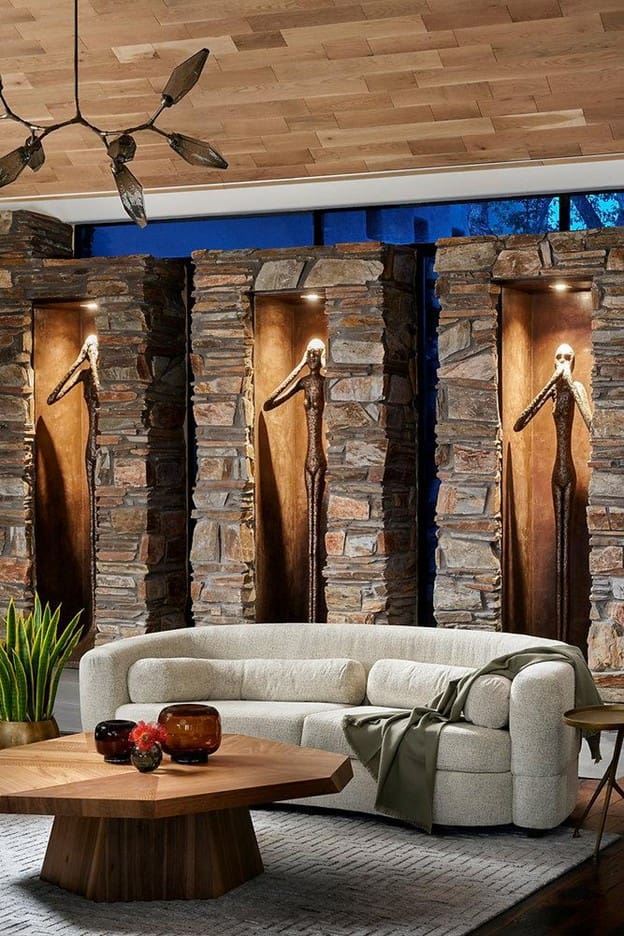
Desert Modern interiors embody a disciplined fusion of minimalist lines and inherent desert materiality, leveraging rammed earth walls for their thermal mass and subtle textural depth alongside terrazzo floors that offer polished durability and seamless flow. This approach prioritizes material honesty, incorporating natural stone, reclaimed wood, and organic textiles like linen and jute in sun-washed palettes of sand, bone, and muted terracotta. Unlike Southwestern styles burdened by heavy motifs, cowhides, and dark timbers, Desert Modern maintains airy restraint, ensuring spaces remain functional amid Arizona’s relentless light and heat. For high-end projects in Paradise Valley and Desert Mountain, precise specification of these elements during space planning prevents execution errors, aligning finishes with structural intent from the outset.
Biophilic Design for Arizona Climates
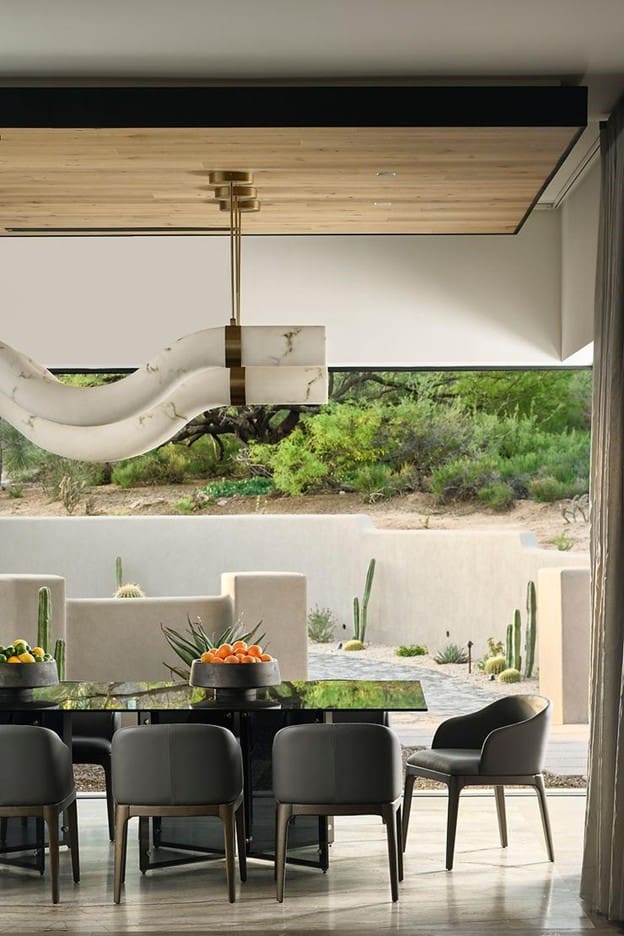
Biophilic principles drive indoor-outdoor continuity through expansive glass systems, clerestory lighting, and matching stone thresholds that extend landscapes inward. In the Sonoran Desert, rammed earth and deep overhangs provide passive cooling, while water features like linear fountains enhance evaporative relief without excess maintenance. This strategy suits Paradise Valley estates, where 300-plus days of sunshine demand designs that harness views of Camelback Mountain while mitigating glare. JSF Design’s detailed construction drawings facilitate builder coordination, ensuring joinery and thresholds execute flawlessly for year-round livability. Explore Desert Modern material strategies.
Architectural Integrity in Paradise Valley
Paradise Valley projects, exemplified by a recent $32.4 million record sale, demand interiors that reinforce skeletal architecture through raw limestone flooring, hand-troweled plaster, and white oak millwork. Material selections honor site-specific geology, with terrazzo accents echoing native aggregates for cohesive sightlines. Collaboration among architects, builders, and designers via comprehensive spec books minimizes field revisions, preserving timelines on custom estates averaging $698 per square foot. This precision elevates property resilience, as seen in biophilic homes nesting into desert contours. Desert Modern architecture guide.
Sustained demand underscores authenticity, with Pinterest boards like “Desert Home” surpassing 360 ideas by 2026, reflecting developer and homeowner focus on timeless, climate-responsive aesthetics over fleeting trends. Terrazzo in Desert Modern.
Strategic Material Selections
In desert home interiors, strategic material selections form the backbone of enduring design, prioritizing performance metrics like thermal regulation, UV stability, and material longevity to align with the Sonoran Desert’s diurnal temperature swings of up to 40 degrees Fahrenheit. At JSF Design, this process begins with meticulous specification books that detail sourcing, finishes, and installation protocols, ensuring architects and builders execute with zero ambiguity in projects across Paradise Valley and Desert Mountain. Organic materials lead this approach, delivering tactile depth that enhances spatial livability while withstanding arid stressors.
Prioritizing Organic Materials: Reclaimed Wood, Local Stone, and Textured Leathers
Reclaimed wood, sourced from regional barns or canyons, introduces patina-rich grains that evolve under Phoenix sunlight, offering longevity exceeding 50 years with proper sealing. Local stone such as Arizona travertine or sandstone provides inherent thermal mass and subtle veining for walls and counters, reducing microclimatic fluctuations by absorbing daytime heat. Textured leathers, vegetable-tanned for natural oil content, resist cracking and fading on high-traffic upholstery, developing a softened character over time. These selections, comprising up to 70 percent of high-end desert projects per regional reports, foster biophilic connections while minimizing maintenance. JSF Design’s detailed drawings specify exact profiles and joins, facilitating seamless collaboration with millworkers.
Terrazzo and Rammed Earth: UV Resistance and Thermal Mass
Terrazzo floors and walls, aggregated from recycled stone in epoxy or cement binders, deliver abrasion resistance and low water absorption ideal for dust-prone environments, maintaining cool surfaces even at 110 degrees Fahrenheit peaks. Rammed earth, compacted from on-site soils in stratified sand-rose tones, leverages high thermal inertia to cut air conditioning demands by 30 to 50 percent, as evidenced in Sonoran projects like those harnessing passive cooling (residential projects in US deserts harnessing thermal mass). Both materials boast UV-stable pigments that prevent discoloration over decades. In Paradise Valley new builds, JSF specifies reinforcement ratios and curing timelines to ensure structural integrity during construction.
Custom Millwork with Warm Finishes
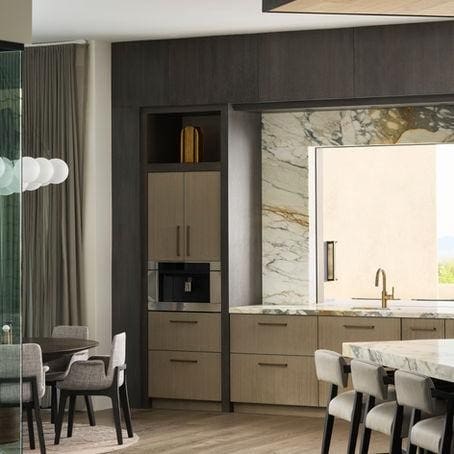
Custom millwork in warm-toned hardwoods like walnut or oak, finished matte to avoid glare, integrates with monolithic architecture through thin brass hardware and floating profiles. These elements frame views to desert landscapes, enhancing indoor-outdoor flow in great rooms averaging 1,500 square feet. Specifications include expansion joints for humidity shifts, guaranteeing precision in spec home timelines.
Incorporating Rice Husk Composites
Emerging rice husk composites, such as those repurposed into wood-like panels, enter 2026 luxury builds with 25-year UV warranties and zero-VOC emissions, slashing construction’s carbon footprint by utilizing agricultural waste. Thermal stability prevents warping in Scottsdale’s extremes, positioning them for cabinetry and cladding in $2.5 million-plus entries (ASID 2026 Trends Outlook).
This curated palette, documented rigorously by JSF Design, elevates property values in a market where Scottsdale luxury sells at $698 per square foot, ensuring resilient, market-ready interiors through builder partnerships.
Color and Texture Palettes
Sun-Washed Neutrals as Foundational Palettes
Desert home interiors in Scottsdale and Paradise Valley rely on sun-washed neutrals such as bone, rust, and terracotta to establish cohesive palettes that mirror the Sonoran Desert’s diffused light and earthen strata. These hues, including sandy beiges like Benjamin Moore’s Driftwood 2107-40 and Sherwin-Williams’ Mesa Tan SW 7695, provide tonal continuity across walls, millwork, and upholstery, eschewing stark contrasts that disrupt spatial harmony. In high-end projects, JSF Design specifies these palettes in detailed construction documents to guide builders toward precise material matches, ensuring UV-stable finishes that withstand Arizona’s intense sunlight. Avoiding cool grays or pure whites prevents visual fatigue; instead, subtle gradients foster a grounded ambiance, as evidenced by recent Paradise Valley sales averaging $698 per square foot where such palettes enhance market appeal. This approach aligns architectural intent with lived experience, supporting thermal performance in climates where interiors must regulate heat without mechanical overreliance.
Layering Textures for Tactile Depth
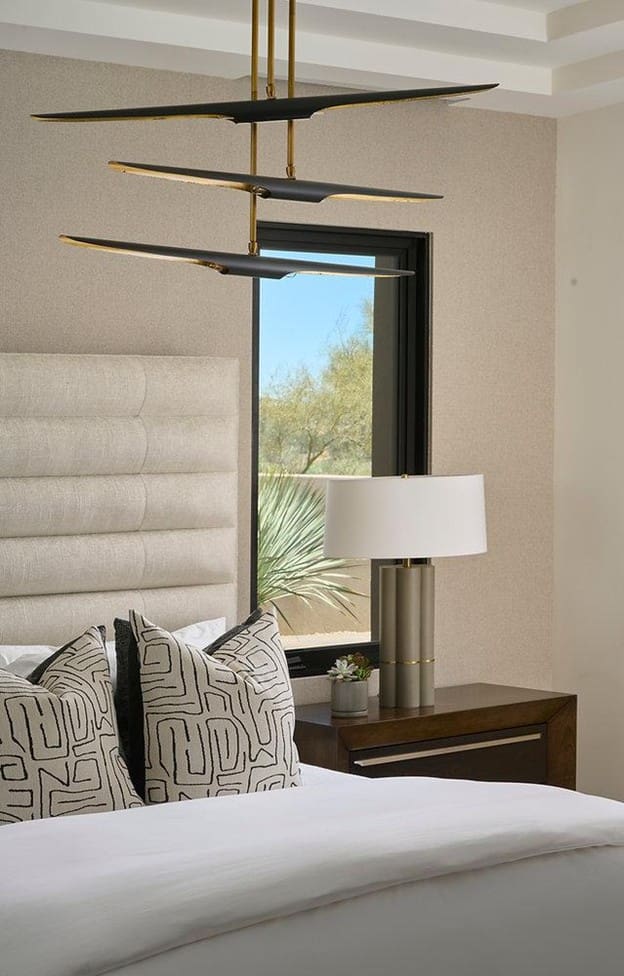
Textures amplify neutral palettes through layered applications of woven natural fibers, handmade pottery, and soft leathers, introducing warmth and patina potential critical for durable luxury residences. Woven wool rugs and linen draperies form base layers, while terracotta vessels and boucle accents add mid-level tactility; supple leathers on custom seating provide forgiving, age-enhancing surfaces. JSF Design coordinates these via comprehensive schedules, collaborating with fabricators to source imperfect, natural materials that reflect light variably across expansive great rooms typical in Desert Mountain homes. Practical execution demands matte plasters on walls paired with bronze hardware for restrained gleam, countering minimalism’s austerity without visual clutter. Desert modern design guide highlights how such layering evokes weathered rock, enhancing sensory engagement in 2,500+ square foot living areas.
Desert Wash Colors and Sonoran Integration
Desert wash techniques apply stratified washes in terracotta, sand, and ochre to walls and floors, infusing subtle depth that directly references Sonoran canyons and dunes. Rammed earth or limewash applications create striated effects, tying interiors to the landscape while improving acoustic and thermal qualities. In JSF Design’s process, these are rendered in scaled elevations for architect-builder alignment, minimizing on-site revisions in timeline-sensitive new builds.
2026 Trends in Soft Desert Luxury
By 2026, palettes shift toward soft desert luxury with organic minimalism, as 33% of buyers favor calming neutrals per design reports, favoring terracotta over fading bold schemes. Desert wash colors; warm earthy minimalism. This evolution prioritizes resale value in $2.5-3 million entry-luxury segments.
Spatial Planning for Flow
In desert home interiors, spatial planning prioritizes fluid circulation that capitalizes on the region’s expansive sites and temperate climate, creating environments where architecture and daily life converge without compromise. At JSF Design, this begins with meticulous zoning diagrams produced during concept phases, ensuring every transition supports both grand-scale entertaining and intimate reprieve. For instance, in Paradise Valley new constructions averaging $698 per square foot, optimized layouts prevent the common pitfall of oversized voids that undermine functionality.
Pocket doors and expansive glass systems dissolve boundaries between primary living areas and patios, extending rammed earth or terrazzo flooring seamlessly outdoors to foster biophilic continuity. These elements, often high-performance units with low-E coatings, reduce solar heat gain by up to 30 percent while admitting horizon views of saguaros and distant mountains. In a recent Desert Mountain project, JSF Design specified slim aluminum-framed sliders that recess fully, paired with automated shading to manage intense midday light; this approach not only enhances airflow but also aligns with builder timelines by integrating into structural openings from the outset. Learn more about luxury desert home planning.
Zoning strategies delineate entertaining hubs, such as great rooms flowing to outdoor kitchens for 20-plus guests, from private wings like master suites buffered by courtyards. This balance employs strategic pivots, including half-walls clad in stucco or palo verde screens, preserving openness in 5,000-plus-square-foot homes while safeguarding seclusion. JSF Design’s detailed plans incorporate circulation radii of at least 4 feet in high-traffic zones, informed by client lifestyle audits.
Coordination with architects during schematic design locks in structural alignments, such as beam placements that accommodate pocket door tracks without field modifications, averting delays that can inflate budgets by 10-15 percent. JSF Design’s specification books facilitate this, providing builders with scaled elevations and sections for precise execution.
Furniture layouts reinforce functionality, positioning low-profile modular groupings, like linen-upholstered sectionals and powder-coated steel consoles, to maintain 36-inch pathways in kitchens and family rooms. Durable, UV-stable selections ensure longevity amid heavy use, with traffic patterns modeled in 3D renderings to preempt bottlenecks. This disciplined process, evident in Scottsdale spec homes fetching $2.5-3 million entry prices, elevates property value through lived-in precision. Explore 2026 desert market trends.
Market Insights and Value Drivers
Scottsdale Luxury Sales at $698 per Square Foot
Recent November 2025 data reveals Scottsdale luxury homes north of $2 million averaging $698 per square foot across 91 closed sales, with properties at $3.06 million average and 114 days on market. This pricing underscores the premium commanded by intentional desert home interiors, where resolved designs featuring rammed earth accents, honed stone floors, and seamless indoor-outdoor transitions reduce buyer hesitation and customization needs. Builders and developers report that such cohesive executions, documented through precise specification books, align architectural intent with material performance, sustaining per-square-foot values even amid 638 active listings. For spec projects, this translates to faster absorption; a North Scottsdale estate with durable Piet Boon-inspired finishes closed at exactly $698 per square foot, demonstrating how thermal-mass materials and neutral palettes mitigate market softening. JSF Design’s construction drawings facilitate this precision, ensuring trades execute without deviation.
Paradise Valley’s $32.4 Million Benchmark
The $32.4 million sale of a 15,500-square-foot Paradise Valley estate in August 2025 set Arizona’s record, approximating $2,090 per square foot and highlighting demand for fully integrated designs. Buyers prioritize turnkey compounds with wellness centers, custom millwork, and desert-aligned materiality like terrazzo and reclaimed wood, which elevate perceived value over raw architecture. This transaction, amid 15 percent price reductions in ultra-luxury listings, affirms that detailed interior resolution drives outsized returns. For affluent homeowners, collaborating with firms like JSF Design minimizes execution risks through on-site oversight and material sourcing.
Resilience in the $2.5-3 Million Segment
Entry-level luxury at $2.5-3 million in Paradise Valley and Scottsdale projects resilience through timeless finishes such as limewash walls, walnut cabinetry, and unlacquered brass hardware, which endure UV exposure and daily use. These elements support 14 percent projected national sales growth into 2026, with sustainable features like high-efficiency glazing reducing long-term costs. Developers note shorter market times for properties with biophilic integrations, projecting stability as inventory rises. Scottsdale and Paradise Valley market update.
Desert Mountain Resale Premiums
Cohesive interiors in Desert Mountain boost resale by adhering to community guidelines for stone facades and open plans, yielding 10-15 percent value uplifts via tactile neutrals and art-ready millwork. With 46 recent closings at $2.84 million average and 132 days on market, these designs enhance streetscape harmony and Sonoran views, appealing to multigenerational buyers. Structured processes from concept to installation, as employed by JSF Design, ensure durability and broad marketability. Luxury design trends for 2026.
Execution Through Documentation
In desert home interiors, execution hinges on meticulously crafted specification books and construction drawings that eliminate interpretive gaps between design intent and builder execution. These documents encompass detailed floor plans, reflected ceiling plans integrating mechanical, electrical, and plumbing systems, comprehensive material schedules specifying UV-resistant finishes and abrasion-tolerant surfaces suited to Phoenix’s dust-laden environment, and annotated shop drawings for custom millwork. For instance, a spec book for a Paradise Valley residence might delineate precise tolerances for rammed earth wall integrations, ensuring thermal mass performs as modeled amid 110-degree summers. JSF Design’s documentation standards, produced in CAD and BIM formats, enable digital handoffs to architects and contractors, fostering real-time clarifications via shared portals.
Collaboration unfolds across defined phases, from concept programming—where client lifestyles inform spatial adjacencies for indoor-outdoor flow—to turnkey installation. During design development, material mockups test desert-specific durability, such as low-VOC stone sealants against alkaline soils; construction administration then involves weekly site walks with trades to approve submittals. This phased coordination aligns MEP rough-ins with furniture footprints, preventing costly rerouting in multimillion-dollar Desert Mountain new builds.
Timeline management in these projects, often spanning 12 to 18 months, incorporates 15 to 20 percent contingencies for permitting delays common in Paradise Valley. Budget controls track variances through serialized schedules, with luxury remodels at $400 to $1,000 per square foot demanding vigilant procurement of six-month-lead custom pieces. Recent Scottsdale data shows sold prices averaging $698 per square foot, underscoring how precise tracking preserves property value.
Ultimately, this precision curtails change orders, which industry-wide drive over 50 percent of overruns, by preempting discrepancies in as-built conditions. In Paradise Valley remodels uncovering unpermitted alterations, upfront LiDAR scans and exhaustive elevations minimize rework, delivering interiors that endure market cycles while enhancing resale appeal.
2026 Outlook and Considerations
Smart-Integrated Biophilic Elements in Arizona Luxury
Desert home interiors in Paradise Valley and Desert Mountain will see accelerated adoption of smart-integrated biophilic elements by 2026, driven by demands for wellness amid extreme climates. Systems like Control4 hubs will automate clerestory lighting, zoned ventilation for living walls, and AI-driven shading to optimize natural light and humidity for indoor greenery. This integration enhances air quality and circadian rhythms, with projects featuring floor-to-ceiling glass framing Sonoran vistas alongside water features for microclimate control. Recent Paradise Valley examples demonstrate limestone floors extending to outdoor realms, reducing perceived indoor temperatures by up to 10 degrees Fahrenheit through material continuity.
Sustainable Material Innovations for Property Longevity
Anticipate advancements in desert-resilient materials, such as reclaimed Sonoran stone, VOC-free clay plasters, and heat-reflective stucco, which extend surface life beyond 50 years under 110-degree Fahrenheit summers. Low-E glazing cuts UV heat gain by 40 percent, while owned solar arrays with battery storage enable net-zero operation, adding 4 to 6 percent to resale values in Scottsdale listings averaging $698 per square foot. Closed-cell foam insulation and high-SEER heat pumps minimize maintenance cycles, aligning with xeriscape irrigation that reduces water use by 50 to 75 percent. These selections ensure generational durability without compromising architectural intent.
Aligning with Buyer Preferences for Functional Sophistication
Evolving preferences favor multifunctional spaces in luxury desert homes, including convertible offices with integrated storage and spa-like primaries with steam fixtures. Indoor-outdoor transitions via folding glass to courtyards with native plantings address privacy and cooling needs, resonating with buyers prioritizing lifestyle alignment over footage. Earthy ochre and rust palettes layered with tactile woods meet demands for quiet luxury, boosting appeal in a market where entry-level Paradise Valley properties start at $2.5 million. Surveys indicate energy-efficient features now rank top for 2026 purchases.
Structured Processes Amid Market Volatility
JSF Design’s documentation-driven approach, with precise specification books and drawings, proves essential for navigating 2026’s stabilizing Phoenix market, where inventory nears 27,000 listings and prices hold firm despite 6 percent rates. This methodology fosters collaboration among architects, builders, and trades, mitigating delays in volatile conditions like extended days-on-market in balanced suburbs. Affluent clients and spec developers benefit from clarified timelines and budgets, ensuring execution aligns with long-term value drivers such as biophilic and sustainable integrations.
Actionable Takeaways for High-End Projects
For high-end desert home interiors in Paradise Valley and Desert Mountain, commission detailed site assessments early to evaluate solar exposure, microclimates, and topography. These analyses dictate material selections, such as rammed earth walls with proven thermal mass coefficients exceeding R-2 per inch, and spatial layouts that maximize biophilic connections without compromising privacy on expansive lots.
Engage multidisciplinary teams, including architects, builders, and firms like JSF Design, from schematic design phases to ensure architecture and interiors align precisely. This collaboration mitigates change orders, which average 15-20% of budgets in luxury builds per industry benchmarks.
Invest in comprehensive documentation, including scaled construction drawings and material specification books, to streamline execution and reduce field errors by up to 30%. Prioritize durability testing for desert stresses like 120°F peaks and UV indices over 12, validating finishes such as UV-stabilized terrazzo or anodized metals.
Schedule consultations with Scottsdale specialists like JSF Design to deliver tailored, precision-executed outcomes that sustain $698 per square foot market values.
Conclusion
In crafting luxury desert home interiors for Arizona’s Sonoran Desert, key strategies emerge as essential. First, prioritize resilient materials like rammed earth walls and UV-resistant textiles to endure extreme heat and sun. Second, integrate cooling innovations such as passive solar shading and evaporative systems for effortless comfort. Third, draw on desert-inspired color palettes from ochre dunes to twilight skies, blending aesthetics with thermal benefits. These approaches transform arid challenges into sophisticated sanctuaries, delivering enduring value through harmony with nature.
Elevate your Arizona residence today. Consult a specialist designer or audit your space with these principles to unlock opulent living. Embrace the desert’s raw beauty; your timeless retreat awaits.

BEST THE EDIT
of
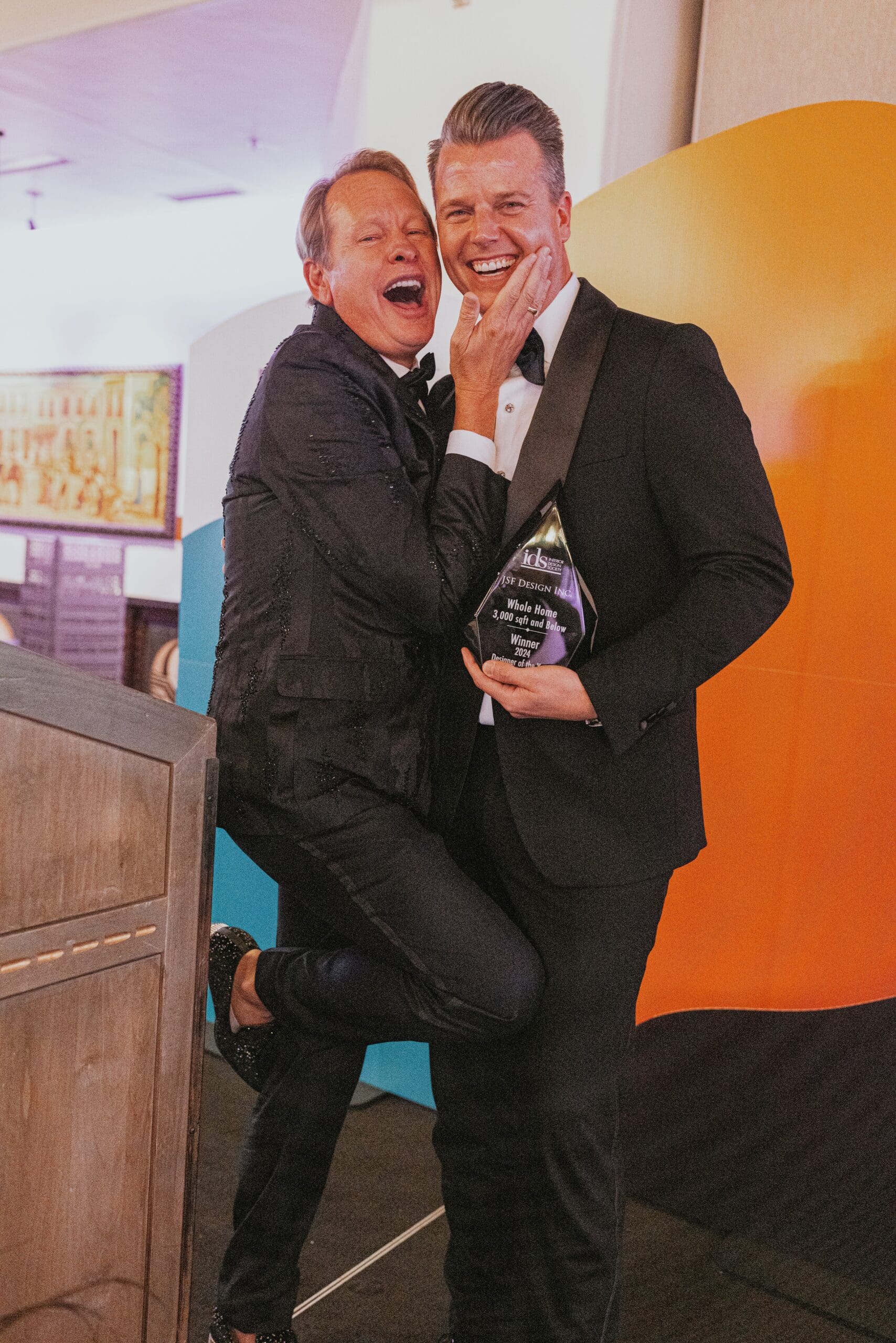
Santa Fe, NM — JSF Design, the nationally recognized interior design studio led by Principal Designer Jeffrey Florentine, received top honors at the 2024 Interior Design Society National Awards Gala in Santa Fe. The firm was awarded Best Home Under 3,000 Sq. Ft. for its project Bungalow, located in the heart of McCormick Ranch, Scottsdale, […]

Elevate Your Space
Let’s Bring Your Vision to Life
Design Goes Beyond Aesthetics...
It Shapes Experience.

+ Show / Hide Comments
Share to: