



In the realm of luxury residential interiors, wood stands as an eternal emblem of sophistication and permanence. Its warm grains and organic textures transcend fleeting trends, anchoring spaces with a quiet authority that synthetic materials can never replicate. Yet, achieving true elegance demands more than mere application; it requires strategic mastery.
This analysis delves into wood decor interior strategies tailored for discerning homeowners and designers. We examine premium wood species, from aged oak to exotic ziricote, and their optimal pairings with contemporary palettes. Discover advanced techniques for milling, finishing, and patination that enhance durability while amplifying visual depth. Learn how to integrate bespoke millwork, sculptural accents, and layered veneers to harmonize with marble, brass, and glass in high-end settings.
Readers will gain actionable insights to elevate their projects: balancing scale for grandeur, mitigating acoustic challenges in open plans, and sourcing sustainable options without compromising opulence. Whether reimagining a penthouse library or a coastal estate, these principles ensure wood not only adorns but defines luxury. Prepare to refine your approach with precision and foresight.
The Strategic Role of Wood Decor in Luxury Interiors
Wood decor serves a pivotal function in luxury interiors by tempering the precision of modern minimalism with inherent organic warmth. This balance introduces subtle texture and depth to expansive, clean-lined spaces, fostering environments that prioritize both visual restraint and sensory comfort. Biophilic design principles underpin this approach, particularly through “Material Connection with Nature,” where rift-sawn oak paneling or walnut millwork evokes natural ecologies and reduces occupant stress. Research from Terrapin Bright Green documents how such minimally processed woods lower blood pressure, elevate cognitive function, and promote restoration, directly enhancing wellbeing in high-end residences. For Scottsdale homeowners, this translates to sustained property value premiums, as biophilic elements appeal to wellness-oriented buyers in competitive markets like Paradise Valley and Desert Mountain. Studies confirm that these features drive resale uplifts through perceived prestige and long-term livability.
Market projections underscore wood decor’s momentum. The wood decorative wall panel sector anticipates reaching $18.41 billion by 2035, expanding at a 4.02% CAGR from 2025, propelled by demand in luxury renovations and personalized high-end projects, per Market Research Future. Paralleling this, the real wood trim market grows at a 3.9% CAGR over the same period, reflecting preferences for sustainably sourced hardwoods like FSC-certified walnut and cherry.
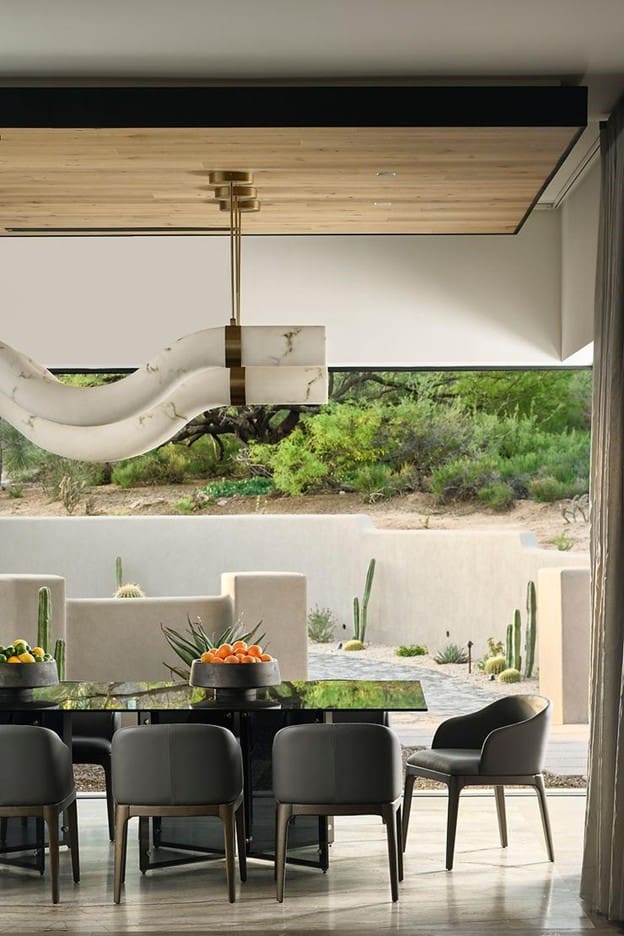
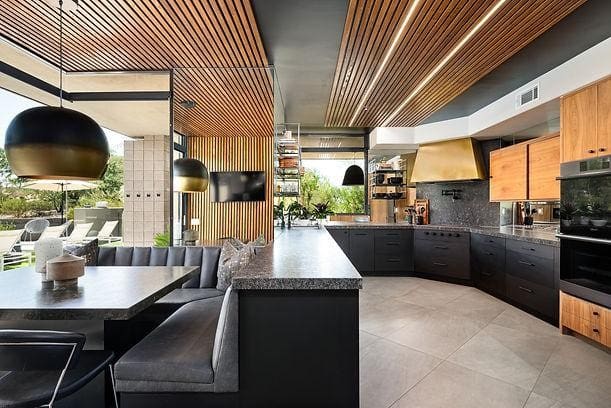
In Scottsdale’s desert residential aesthetic, wood strategically layers texture over modernist frameworks, yielding livable sophistication suited to arid conditions. Custom beamwork or fluted panels in open great rooms harmonize with stone flooring and vast glazing, mitigating solar glare while amplifying indoor-outdoor connectivity. This alignment demands precise material selection, such as UV-resistant thermally modified ash, coordinated via detailed specification books that ensure seamless architect-builder execution.
Practical advantages further justify wood’s prominence: dense species like ipe withstand intense UV exposure without fading, while perforated panels deliver acoustic absorption in voluminous open plans, curtailing reverberation by up to 50%. Unlike synthetic alternatives, wood’s patina develops gracefully, transcending trends for enduring appeal.
For affluent homeowners and spec builders, wood decor constitutes a calculated investment in heirloom-quality environments. JSF Design’s documentation-driven process, from millwork drawings to on-site oversight, realizes this vision with precision, aligning architectural intent and material performance to maximize property longevity and market distinction.
2026 Trends in Wood Decor Applications
In luxury residential projects across Scottsdale, Paradise Valley, and Desert Mountain, wood decor interior applications are shifting decisively toward rich, warm tones that counter the stark minimalism of recent years. Species such as walnut, with its deep, flowing grain; cherry, offering balanced warmth; rift-sawn oak, prized for straight-line stability; and maple accented by beige undertones now dominate specifications. This evolution, as noted by Woodgrain’s top 10 interior trends for 2026, responds to client demands for emotional depth and longevity in high-end homes. Designers at firms like JSF Design Inc. integrate these tones through precise material schedules, ensuring compatibility with desert climates where thermal stability and UV resistance are critical. Practical execution involves sourcing quartersawn cuts for minimal expansion, collaborating with architects early to align with structural beams, and budgeting for custom finishing processes that enhance grain without artificial distressing. The North American wooden furniture market underscores this momentum, projected to reach USD 190.47 billion in 2026, up from USD 188.37 billion the prior year.
Revival of Wood Paneling: Fluted Walls, Shiplap Ceilings, and 3D Geometric Panels
Wood paneling reemerges as a structural focal point, transforming entryways and great rooms into refined spatial anchors. Fluted or reeded walls, with vertical grooves modulating light, pair seamlessly with shiplap ceilings for subtle overhead texture, while 3D geometric panels add dimensionality without overwhelming open plans. Houzz’s 2026 trend analysis highlights buyer preference for these applications in smoked oak or walnut, elevating property value through biophilic resonance. In construction, JSF Design’s detailed shop drawings facilitate millwork fabrication, minimizing on-site errors and timelines; rift-sawn panels, for instance, resist warping in Phoenix’s humidity swings. Builders report 20-30% faster installation with prefabricated systems, though premium sustainable sourcing adds 15% to material costs, offset by durability exceeding 50 years.
Mixing Wood Tones for Spatial Depth
Layering tones creates intentional contrast, such as light oak flooring with dark walnut cabinetry, extending to large-format planks that unify expansive living areas. This approach, endorsed by interior forecasters, leverages warm undertones for cohesion across kitchen-to-great-room transitions. Spatial planning benefits from mock-ups during schematic design, allowing architects and builders to test sightlines and scale.
Sustainable Textured Applications in Desert Modern Contexts
Reclaimed or rift-sawn woods define textured elements like kitchen islands and accent walls, paired with veined stone for grounded desert modern palettes. Provenance documentation ensures FSC certification, appealing to affluent clients prioritizing legacy investments. JSF Design’s specification books streamline procurement, coordinating with trades for seamless integration and reducing change orders by up to 40%. Market projections affirm growth, with wood decorative wall panels reaching $18.41 billion by 2035 at a 4.02% CAGR, driven by luxury renovations. This measured evolution positions wood as a enduring collaborator in precision-executed interiors.
Material Selection and Specification for Desert Climates
In Phoenix-area projects, where summer temperatures routinely exceed 110°F, relative humidity hovers at 10-30%, and intense UV radiation penetrates expansive glazing, wood selection demands species with exceptional dimensional stability and photostability. Black walnut (Juglans nigra), with its Janka hardness of 1,010 lbf and inherent oils, proves ideal for cabinetry; it resists UV-induced fading, developing a rich patina that enhances depth in sun-exposed kitchens common to Paradise Valley estates. Rift-sawn white oak (Quercus alba) suits flooring and millwork, its closed grain limiting contraction to under 5% during dry heat cycles, as confirmed by local experts acclimating materials to 6-8% moisture content. These choices align with 2026 forecasts showing walnut-oak pairings in 70% of Southwest luxury homes, balancing architectural crispness with organic warmth.
Finish Options for Endurance and Visual Comfort
Low-VOC oils, such as tung or linseed formulations under 50 g/L VOC, penetrate deeply to foster natural aging while accommodating seasonal expansion. Applied in 2-3 coats post-acclimation, they include UV inhibitors for edge protection, outperforming lacquers in flexibility. Matte sheens (gloss below 10%) reduce glare across Arizona’s 300+ annual sunny days, critical in open-plan great rooms with floor-to-ceiling glass. Regional data indicates these finishes dominate 80% of sustainable remodels, slashing indoor pollutants by 90%.
Sourcing and Durability Strategies
FSC-certified walnut and oak from Southwest suppliers ensure chain-of-custody integrity, elevating prestige in Desert Mountain spec homes while cutting deforestation impact by over 50%. For durability amid monsoon humidity spikes to 60% RH, specify moisture-resistant sealers, kiln-drying to 6% MC, and edge-banding; integrate with HVAC systems holding 40-55% RH and 68-72°F via humidistats to prevent gapping over 1/16 inch. Untreated woods fail twice as fast, but these measures extend lifespan to 20-30 years, per Arizona standards.
Firms like JSF Design deliver precision through exhaustive specification books, detailing species, finishes, sourcing, and AWI-compliant tolerances with CAD drawings and mockups. This documentation minimizes builder errors by 30-50%, fostering seamless collaboration among architects, trades, and owners in multimillion-dollar builds. For details on desert wood impacts, see temperature and humidity effects on cabinetry and how temperature affects wood.
Integrating Wood Through Design and Construction Collaboration
Space Planning: Proportioning Wood Elements to Architecture
In high-end residential projects throughout Scottsdale and Paradise Valley, space planning begins with proportioning wood elements to reinforce architectural intent. Wood paneling, cabinetry, and accents are scaled to room volumes, ensuring vertical elements like rift-sawn oak slats extend from floor to soffit for rhythmic continuity that guides sightlines in open-plan great rooms. This approach leverages material grain direction to delineate zones without physical barriers, harmonizing with expansive glazing common in Desert Mountain homes. 3D modeling software enables precise paneling layouts, simulating fluted profiles or geometric patterns with parametric precision to optimize acoustics, achieving noise reduction coefficients up to 1.00, and light diffusion before fabrication. For instance, in a 5,000-square-foot new build, modeling reveals how walnut veneers on ceilings modulate desert sunlight, preventing glare while enhancing spatial depth. JSF Design employs these tools to align wood applications with structural geometry, delivering measurable improvements in perceived scale and functionality.
Custom Millwork Design: From Concept Sketches to Shop Drawings
Custom millwork design progresses methodically from hand-sketched concepts, which capture architectural motifs like roofline cantilevers, to fully dimensioned shop drawings. Iterative CAD elevations and sections incorporate field-verified measurements, specifying joinery details such as mitered reveals and floating shelves with 1/16-inch tolerances. Coordination with architects ensures seamless transitions, such as wood encasements aligning with concrete beams or stone plinths, preempting clearance issues for integrated appliances. In Phoenix-area remodels, this yields built-ins that conceal HVAC diffusers while exposing select grain patterns for textural interest. The process mitigates risks like thermal expansion in low-humidity climates, using species like quartersawn maple for stability.
Documentation-Driven Approach: Minimizing On-Site Errors
JSF Design’s structured documentation sets projects apart, featuring comprehensive specification schedules that enumerate wood species, thicknesses, quantities, and hardware pairings. Finish samples, including physical swatches of custom stains matched to Sherwin-Williams codes, secure approvals alongside digital renders for performance validation. Construction drawings detail plans, sections, and installation sequences, complete with blocking notes and expansion joint diagrams to prevent warping in arid conditions. This precision reduces change orders by up to 30 percent, as evidenced by industry benchmarks in luxury millwork execution. Clients benefit from indexed binders that streamline trades coordination, ensuring walnut cabinetry arrives pre-finished and ready for Z-clip mounting.
Collaboration: Pre-Construction Alignment in Desert Mountain Projects
Pre-construction meetings with builders in Desert Mountain establish unified timelines and budgets, reviewing wood integration against six-to-nine-month construction phases. These sessions dissect millwork scopes alongside concrete pours and glazing installs, aligning on procurement lead times for FSC-certified hardwoods amid supply chain fluctuations. For a recent spec home, stakeholders synchronized walnut island detailing with zinc counter fabrication, averting delays that could inflate costs by 15 percent.
Execution Realities: Phased Installations and Quality Control
Execution demands phased installations: rough-ins precede millwork delivery, followed by finishing to shield oil-rubbed walnut from dust in remodels. Quality control protocols include laser alignments and moisture metering, critical as the wood decorative wall panel market surges toward $18.41 billion by 2035 at a 4.02 percent CAGR. JSF Design oversees final punch lists, safeguarding long-term durability in high-UV environments. This rigor translates to interiors that endure, elevating property values through intentional craftsmanship. For deeper trends, see 2026 interior design trends.
Wood Decor in Paradise Valley Residential Projects
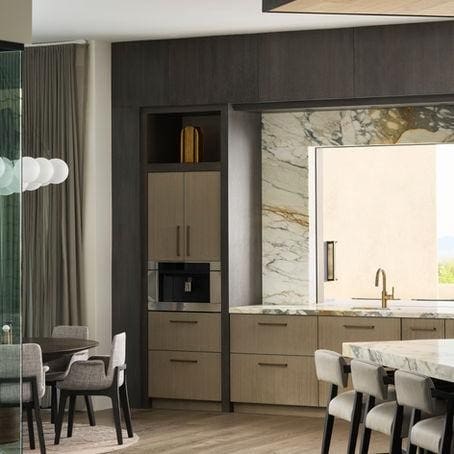
In Paradise Valley residential projects, wood decor interior strategies leverage rift oak and walnut to instill grounded warmth within desert contemporary frameworks, countering expansive glass and stone with tactile depth. JSF Design’s portfolio exemplifies this through rift oak cabinetry in Scottsdale-area remodels, where the rift-cut grain delivers uniform linearity and subtle texture. This specification, detailed in comprehensive construction drawings, ensures precise execution by builders, aligning with architectural volumes while resisting low-humidity degradation common in Phoenix climates.
Walnut Kitchen Islands as Anchors in Open Plans
Walnut kitchen islands anchor expansive open plans, establishing material hierarchy that guides visual flow from living to dining zones. In JSF Design projects proximate to Paradise Valley golf courses, walnut’s rich patina grounds quartzite surfaces and lighter millwork, fostering seamless entertaining spaces. Collaborative specification with architects prioritizes 3-inch overhangs and integrated appliances, enhancing functionality without disrupting sightlines.
Textured Oak Wall Paneling for Zoned Definition
Textured oak accents, such as fluted or reeded panels, delineate zones in vast great rooms without overwhelming architecture. JSF Design applies these in Paradise Valley homes, pairing wide-plank rift oak with concealed storage to balance openness and utility. This approach, documented via detailed elevations, facilitates trade coordination and minimizes on-site revisions.
Outcomes manifest in elevated spec home readiness; Houzz’s 2026 predictions note wood cabinets as the top kitchen choice, with 62% of renovators prioritizing durable species for 11+ year tenures. Clients report sustained timelessness, boosting resale premiums in Desert Mountain listings.
From initial drawings to installation, wood unifies environments via JSF Design’s specification books, ensuring material continuity across phases and delivering cohesive, investment-grade interiors. View JSF Design portfolio.
Actionable Takeaways for High-End Wood Decor Implementation
- Select wood species and finishes calibrated to Scottsdale’s environmental rigors, such as rift-sawn white oak or walnut with UV-resistant oil finishes. These choices mitigate fading from intense solar exposure exceeding 110°F and low humidity levels of 10-30%, ensuring longevity in Paradise Valley homes. Data from the wood decorative wall panel market projects $18.41 billion growth by 2035 at 4.02% CAGR, underscoring demand for durable applications.
- Involve interior designers from schematic design phases to produce integrated specifications that align with architectural drawings, minimizing builder change orders by up to 20% in multimillion-dollar projects.
- Commit to bespoke documentation, including detailed millwork schedules and material boards, to protect the design intent and control budgets during construction.
- Arrange consultations with Phoenix-area specialists like JSF Design to evaluate prototypes on-site, facilitating precise execution through their structured specification process.
- Evaluate outcomes via sustained metrics: biophilic wellbeing gains, minimal maintenance, and resale premiums, as seen in Behance wood decor projects enhancing property prestige.
Conclusion
In summary, luxury wood decor thrives on selecting premium species like aged oak and exotic ziricote paired with contemporary palettes, mastering advanced milling, finishing, and patination techniques for enduring depth, integrating bespoke millwork and veneers with marble, brass, and glass, and balancing scale while mitigating acoustics in open plans.
These actionable strategies deliver timeless sophistication that synthetic alternatives cannot match. They equip discerning homeowners and designers with the tools to anchor spaces in quiet authority and elevate projects to new heights of elegance.
Implement these insights in your next interior endeavor today. Transform ordinary residences into enduring legacies of luxury.



BEST THE EDIT
of
Santa Fe, NM — JSF Design, the nationally recognized interior design studio led by Principal Designer Jeffrey Florentine, received top honors at the 2024 Interior Design Society National Awards Gala in Santa Fe. The firm was awarded Best Home Under 3,000 Sq. Ft. for its project Bungalow, located in the heart of McCormick Ranch, Scottsdale, […]

Elevate Your Space
Let’s Bring Your Vision to Life
Design Goes Beyond Aesthetics...
It Shapes Experience.

+ Show / Hide Comments
Share to: