


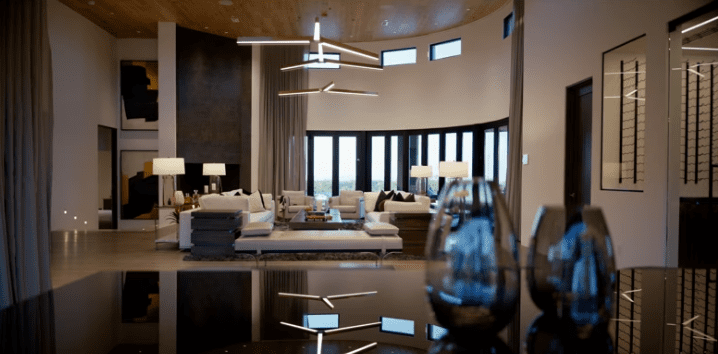
Picture a home that feels both timeless and current, where classic elegance meets contemporary simplicity without feeling forced or overdone. This is the essence of transitional interior design, one of the most sought-after aesthetics among luxury homeowners today.
If you have ever struggled to choose between the warmth of traditional decor and the clean lines of modern style, transitional design offers a sophisticated solution. It bridges two worlds with intention and balance, creating spaces that feel refined yet deeply livable. Unlike trends that come and go, this design philosophy has proven its staying power precisely because it prioritizes harmony over extremes.
In this guide, you will gain a clear understanding of what transitional interior design is, how it differs from other styles, and the core principles that define it. You will also learn how to identify key furniture pieces, materials, and color palettes that bring this aesthetic to life in a luxury home. Whether you are working with an interior designer or curating your space independently, this guide will give you the knowledge to make confident, informed decisions.
Defining Transitional Interior Design
The dictionary definition of “transitional” frames the word around movement, passage, and change between states. Merriam-Webster’s thesaurus goes further, clustering it alongside synonyms like interim, makeshift, and tentative. It is worth addressing this directly: in interior design, the word carries none of those implications. Transitional design is not a placeholder aesthetic, and it is not the result of indecision. It is a deliberately resolved position, one that draws from two well-established traditions and synthesizes them into something more sophisticated than either produces on its own.
The Cambridge Dictionary defines transitional as “belonging or relating to a change, or the process of change, from one form or type to another.” In design terms, that productive tension between classical warmth and contemporary restraint is not a problem to be solved; it is the point. Transitional interiors do not lean hard into the symmetry and ornament of traditional design, nor do they pursue the austerity that contemporary interiors sometimes demand. They occupy a third position, one grounded in formal proportion, material richness, and a restrained but considered approach to detail.
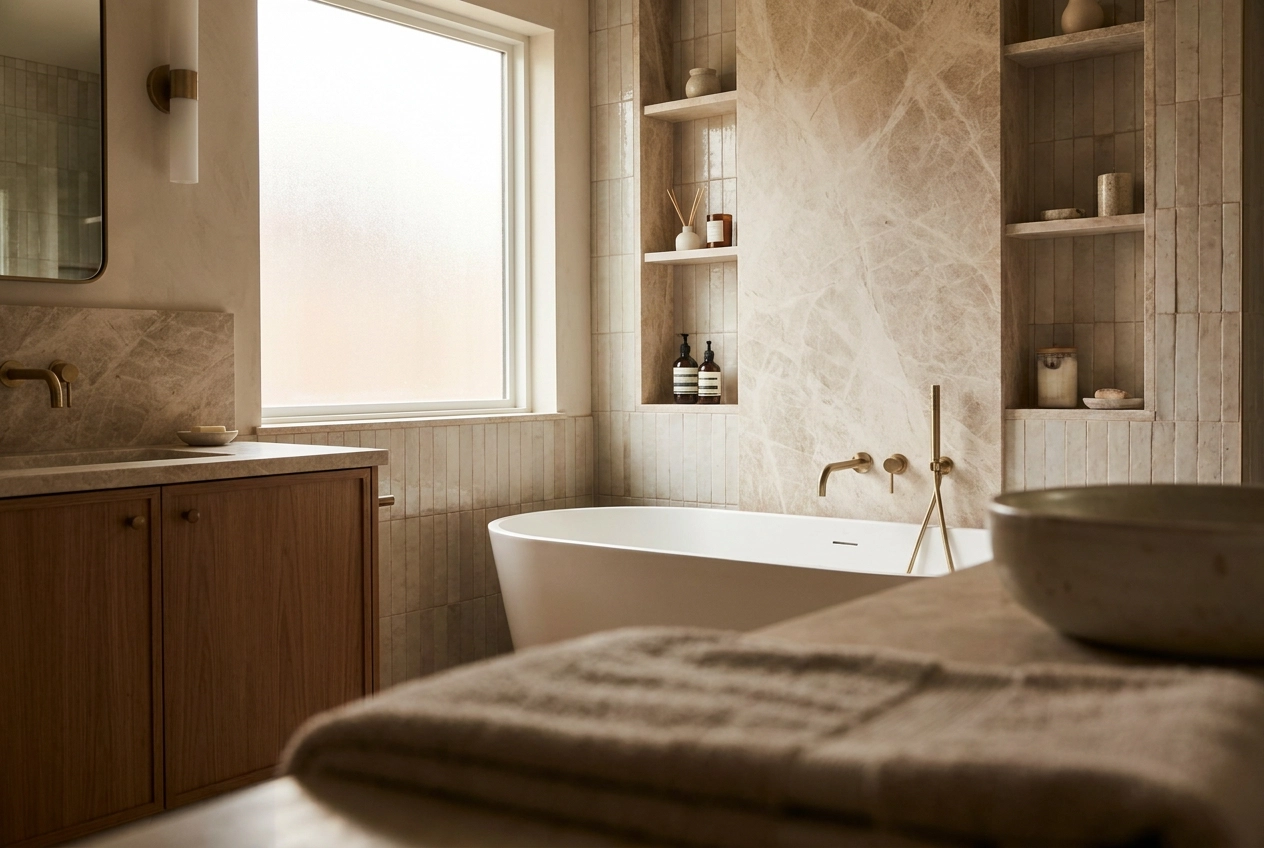
The material and tonal vocabulary of transitional design is specific. Palettes anchor in warm whites, greiges, and soft earth tones, colors that read as neutral without feeling cold or flat. Furniture silhouettes reference classical form, scaled with intention and free of decorative excess. Where a traditional room might lean on pattern to build visual interest, a transitional interior substitutes texture: woven linens, honed stone, wire-brushed oak, aged leather. The layering is deliberate, and the effect is depth without noise.
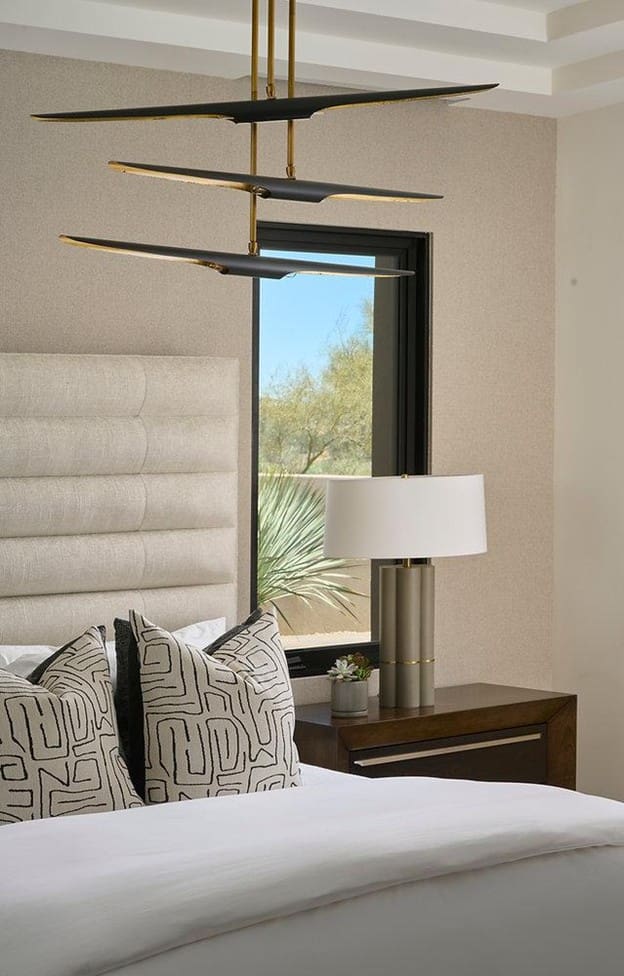
Metal finish selection is one of the more telling indicators of whether a transitional interior has been thoughtfully executed. When aged brass and matte black appear together in a space, they should share a tonal logic, a warmth and weight that makes them feel related rather than contrasted. Contrast for its own sake reads as decorative; tonal consistency reads as considered.
Architectural detail follows the same principle. Cased openings, clean coffered ceilings, and simple millwork profiles bring craft and structure to a room without anchoring it to a specific period. The detail is present and resolved, but it does not announce itself. That quality of restraint, present throughout but never overplayed, is what gives transitional design its lasting residential appeal.
Transitional vs. Adjacent Styles: Where the Lines Fall
Transitional vs. Traditional
Traditional interiors operate within a clear historical framework. The hallmarks are well-established: bilateral symmetry in furniture arrangement, ornate millwork with carved profiles or dentil detailing, heavily patterned textiles drawn from European weaving traditions, and an overall commitment to period authenticity. Every material and furnishing choice in a traditional room references something that came before it. Transitional design draws from the same well of warmth and human scale, but it filters that inheritance selectively. The proportions may echo a traditional room — a substantial sofa, a dining table that seats ten, a fireplace as the room’s organizing axis — but the decorative layer is stripped back. Profiles are cleaner, patterns are quieter, and the historical reference is implied rather than stated directly.
Transitional vs. Contemporary
The distinction between transitional and contemporary design is primarily one of stability. Contemporary design, by definition, reflects the present moment; it shifts with editorial cycles, responds to emerging materials, and is always recalibrating. What reads as contemporary today may feel dated within a decade, precisely because it was never meant to outlast its moment. Transitional design, by contrast, holds a fixed sensibility. It does not experiment for the sake of formal novelty, and it prioritizes livability over the kind of spatial tension that contemporary interiors sometimes court. For clients building or renovating a home in Scottsdale or Paradise Valley, this distinction carries real financial weight. A transitional interior supports long-term property value in a way that a sharply contemporary one may not, because its appeal does not depend on whether the current moment validates it.
Transitional vs. Modern
Modernism, in its formal sense, is an ideology as much as an aesthetic. The mid-century tradition and its derivatives are built on a rejection of applied ornament, a commitment to material honesty, and a belief that form should follow function without embellishment. These are principled positions, and they produce interiors with a recognizable vocabulary: exposed structure, low horizontal profiles, restrained material palettes, and an avoidance of softness that might read as sentimentality. Transitional design can incorporate modern influence without adopting modernism’s rigor. A clean-lined sofa, a low-profile sectional, or a floating millwork unit can all appear in a transitional room. The difference is what surrounds them. Honed limestone, wire-brushed white oak, handwoven textiles, and warm ambient lighting are all natural companions in a transitional interior; they are precisely what a disciplined modernist vocabulary would resist as unnecessary concession.
Transitional vs. Soft Modern and Warm Minimalism
Of all the adjacent categories, soft modern and warm minimalism come closest to transitional design, which makes the distinction worth drawing carefully. Both work within a restrained palette, often built on creams, warm greiges, and natural wood tones. Both favor clean silhouettes over ornate ones. The divergence is in material density and textural layering. Soft modern edits aggressively, prioritizing negative space and resisting accumulation. Transitional design layers with intention: more textile variation, a broader mix of stone and wood, a willingness to introduce objects and accessories that give a room its lived character without tipping into eclecticism.
The Strategic Value of Legibility
For high-value residential properties, this distinction has a practical implication that extends well beyond aesthetic preference. Transitional design is broadly legible. Most buyers, regardless of whether they can identify the style by name, register it as refined, comfortable, and appealing. That legibility is not a sign of compromise; it is a strategic asset. In spec home development and luxury resale markets, the ability to connect with a wide range of qualified buyers without alienating any of them is a meaningful advantage. A room that reads as intentional and livable to nearly everyone who walks through it is a room doing serious commercial work.
Why Transitional Design Holds Its Value
The design decisions made during a project’s specification phase carry consequences that extend well beyond occupancy. In luxury residential markets, particularly across Paradise Valley and Scottsdale where price points are high and buyer scrutiny is exacting, an interior that follows a specific trend too closely carries real obsolescence risk. A maximalist pattern language that felt current in one market cycle can read as dated within three to five years. A hyper-specific color palette tied to a single moment in design media becomes a liability rather than an asset when the property eventually trades. Transitional interiors sidestep this risk by operating within a material and compositional vocabulary that remains legible across multiple market cycles, without requiring buyers to mentally “undo” the existing design before they can imagine living in the space.
Timelessness Is Material, Not Conceptual
When designers discuss timeless interiors, the conversation often stays abstract. In practice, timelessness is a function of specific material choices made at the specification stage. White oak flooring, for example, does not carry the same obsolescence risk as the gray-stained oak finishes that saturated the market a decade ago and have since become reliable markers of a property’s vintage. Leathered quartzite countertops hold their character and relevance across design cycles in a way that high-gloss lacquer surfaces or ultra-white porcelain slabs do not; the texture and variation inherent in natural stone ages with the space rather than against it. Aged brass and unlacquered bronze hardware follow a similar logic: they develop patina over time in a way that polished chrome, which looks precisely correct only when new, cannot. These are not aesthetic preferences in isolation; they are specification decisions with compounding implications for long-term property value.
Strategic Advantage for Spec Builders
For spec home builders operating in the Desert Mountain, Paradise Valley, and Scottsdale corridors, the buyer pool at the $3M-plus price point is both selective and diverse in aesthetic preference. A traditional buyer will read warmth, proportion, and material depth in a well-executed transitional interior. A buyer with contemporary sensibilities will register the clean lines, restrained ornamentation, and absence of decorative excess. Transitional design does not require the buyer to make a significant imaginative concession to see themselves in the space. That functional breadth is a strategic asset in a market where carrying costs are substantial and days-on-market represent real financial exposure.
The cumulative argument is straightforward: transitional design positions a property as investment-grade rather than fashion-forward. For clients whose homes represent significant capital, that distinction carries weight that goes well beyond aesthetics.
The Material Vocabulary of Luxury Transitional Interiors
Material selection is where transitional interior design moves from concept to commitment. The choices made at the specification level determine whether a finished space reads as resolved and intentional or merely neutral. In luxury residential work across Scottsdale, Paradise Valley, and Desert Mountain, a consistent material vocabulary has emerged that honors the core premise of transitional design: warmth without ornamentation, restraint without coldness.
Stone
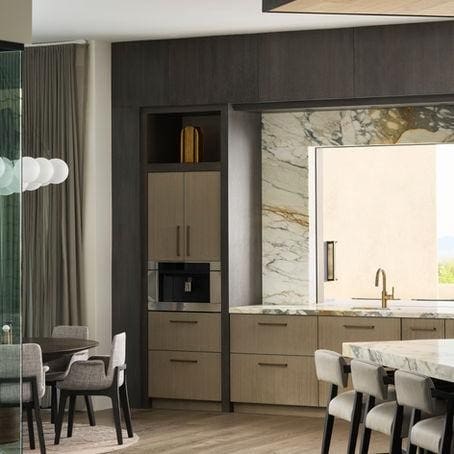
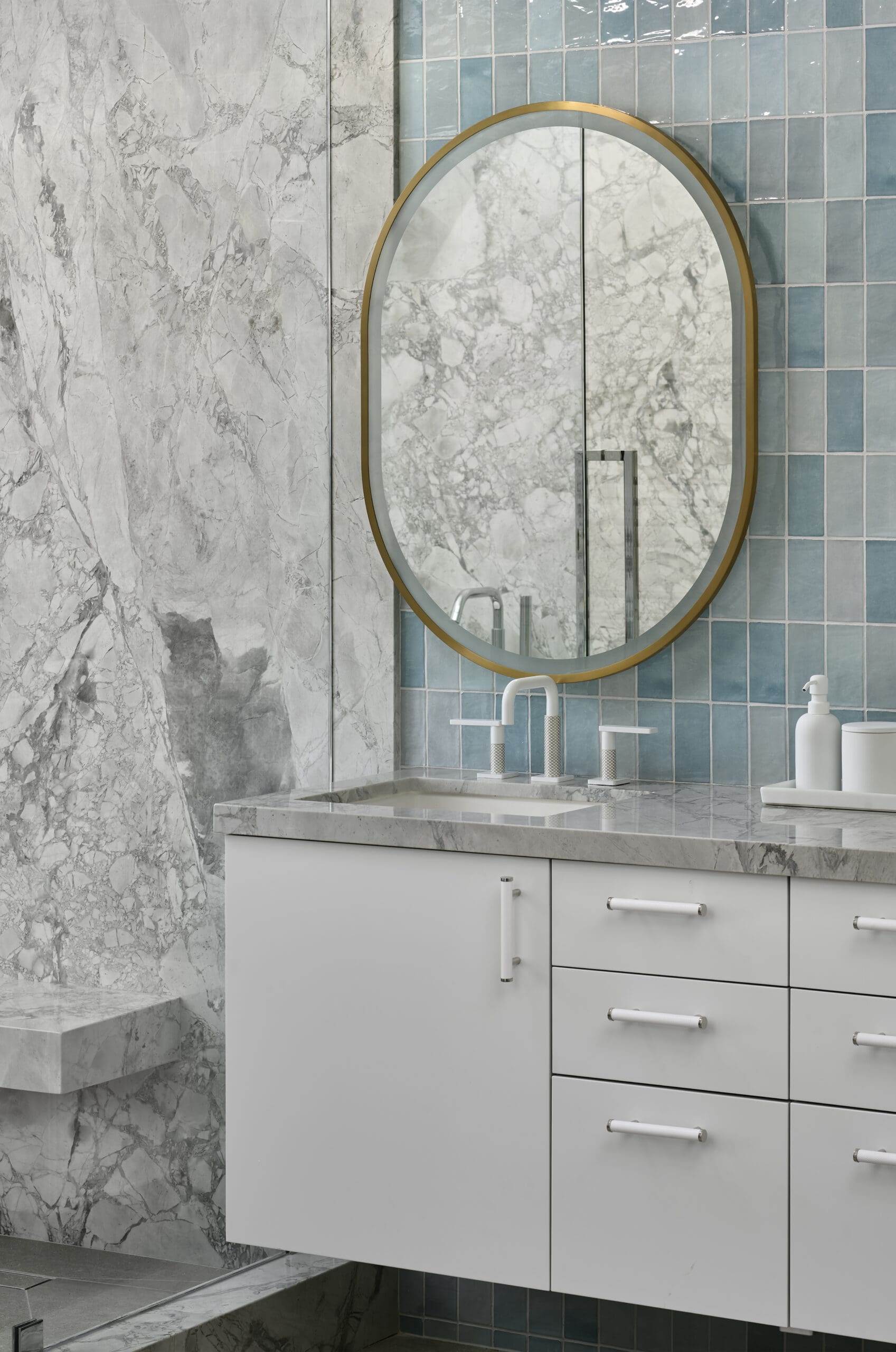
In high-visibility applications, leathered and honed stone finishes have displaced polished surfaces as the specification of choice. Polished stone amplifies reflectivity and draws attention to the material’s surface rather than its character; honed and leathered finishes, by contrast, allow the natural variation, veining, and movement within the stone to register without visual noise. Natural quartzite and marble remain the materials of consequence in this category. They carry density, variation, and a geological authenticity that engineered stone cannot replicate, regardless of how closely it approximates the visual. Bookmatched stone warrants particular attention as an architectural device: a fireplace surround or kitchen island faced with bookmatched quartzite performs formal work simply through its inherent symmetry and pattern. No additional decorative layering is required. The material becomes the composition.
Wood
White oak has established itself as the dominant wood species in current luxury transitional work, and for well-founded reasons. Its grain is present and readable without the aggressive figuring of species like hickory or the dated associations of cherry. It accepts stain and wire-brushing cleanly, which allows the designer to shift the warmth or tone of the material to suit the overall palette. Rift-sawn white oak is particularly well-suited to flooring and cabinetry in transitional projects: the rift-sawing process produces a consistent, linear grain pattern that reads clean and contemporary while the material warmth keeps the space from feeling clinical. Wide-plank formats, generally 6 to 10 inches, contribute appropriate visual weight in the large-volume rooms common to custom desert homes.
Plaster and Wall Finishes
Limewash and Venetian plaster in warm, mid-tone ranges offer something a painted wall cannot: depth that shifts with light. These finishes are not monolithic; they carry variation in tone and surface texture that accumulates across the face of a wall, creating the kind of layered quality that distinguishes a carefully considered room from a finished one. Applied in warm whites, soft ochres, or greyed taupes, rather than the stark whites associated with minimalist contemporary work, they anchor a transitional palette without introducing pattern or competing with other surfaces. They also perform well over time and photograph with exceptional quality, which carries practical significance in both occupied homes and spec properties entering the market.
Metals
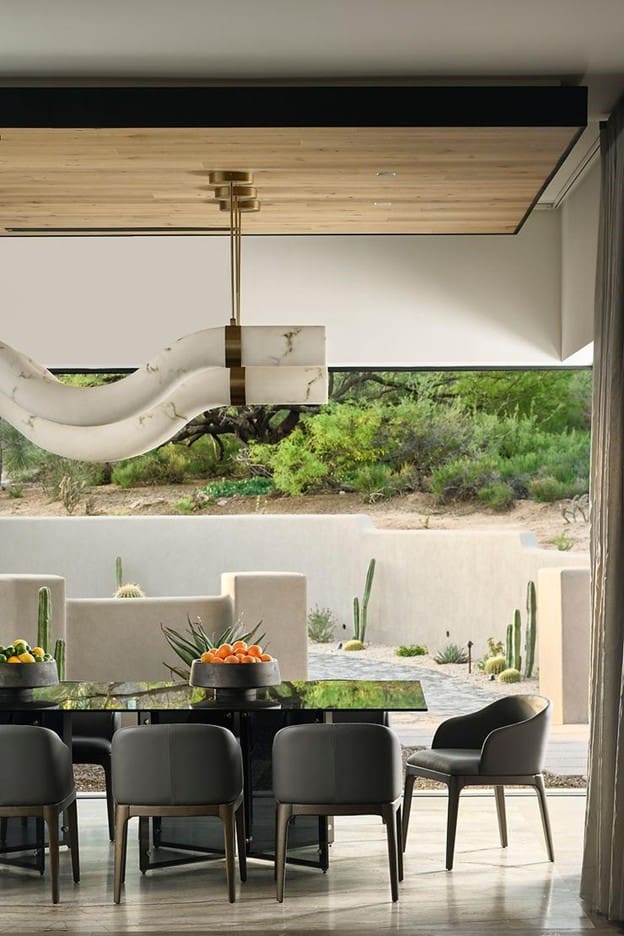
Aged brass, unlacquered brass, and brushed bronze occupy a precise position in the transitional palette. They carry enough warmth to relate to traditional interiors without the heaviness of ornate gilt, and enough restraint to read comfortably alongside clean architectural lines. What makes metal selection consequential at the specification level is the requirement for tonal consistency. Hardware, plumbing fixtures, and lighting must be coordinated across every room and every trade. A documentation-driven specification process makes this coordination explicit rather than leaving it to field interpretation.
Textiles and Millwork
Natural fibers, specifically linen, wool, leather, and cotton velvet, in muted, grounded tones prioritize texture as the primary design variable rather than pattern. This keeps upholstery and drapery from competing with the stone and wood that establish the room’s material hierarchy. Millwork should feel crafted and considered without referencing a specific period: Shaker-adjacent cabinet doors, simple casing with a slight reveal, and floating shelves of substantial thickness accomplish this. The distinction between a transitional cabinet and a builder-grade one often comes down to proportion, reveal dimensions, and hardware placement, and these details must be documented with precision for the finish carpenter to execute them correctly.
Transitional Design in Desert Architecture: A Regional Perspective
The residential architecture of Scottsdale, Paradise Valley, and Desert Mountain creates a specific design condition that few other markets replicate. Clean rooflines, generous ceiling heights, expansive glazing systems, and interior courtyards are structural givens in this region, not aspirational upgrades. These architectural conditions establish a contemporary restraint that demands a complementary interior response: one that introduces warmth, material depth, and tactile richness without disrupting the spatial discipline the architecture has already defined. Transitional design answers that condition directly. It accepts the contemporary framework as a given and layers in the material and compositional elements that make a home feel inhabited rather than simply resolved.
How the Desert Changes the Way Materials Read
Context reshapes perception, and nowhere is this more apparent than in how natural materials perform against an arid landscape. Stone that might read as heavy or formal inside a traditional Northeast Colonial feels grounded and appropriate when set against the desert’s existing palette of sand, rock, and low vegetation. The landscape does the referential work; the interior material simply has to be honest. Similarly, warm wood tones that might register as rustic in another context read as refined here, particularly when used in linear applications such as slab-front cabinetry, wall cladding, or floating shelving. The desert environment tolerates warmth without reading it as decorative excess, which gives the transitional material vocabulary considerable range in this market.
Material Continuity at the Indoor-Outdoor Threshold
High-end Arizona residential architecture is defined, in large part, by its commitment to dissolving the boundary between interior and exterior space. Retractable glass wall systems, covered loggia connections, and flush floor transitions are standard features on projects at this level. That architectural intention places a specific demand on the interior designer: materials must read coherently on both sides of the threshold. Large-format stone flooring that continues from a great room to a covered outdoor living area, or wood ceiling details that extend from interior to exterior soffit, are not decorative choices. They are spatial planning decisions that require coordination between the designer, architect, and builder well before construction begins. Transitional design’s comfort with natural, unornamented materials makes it well-suited to this kind of continuity planning.
Addressing the Desert Climate at the Specification Level
Climate is not an afterthought in this market; it is a specification parameter. UV exposure in the Phoenix metro is substantial, and direct sunlight that enters through large glazing systems will degrade textiles, fade finishes, and accelerate material wear if selections are not made with durability in mind. Performance-grade natural-fiber textiles, specified for UV resistance, allow the warmth and texture of linen or wool to be used without sacrificing longevity. Honed stone surfaces, rather than polished, resist glare and show less thermal variation. Plaster wall finishes, both lime-based and synthetic, accommodate the temperature cycling that characterizes desert homes with significant glass area. These are practical material choices that also happen to align precisely with the restrained, material-forward character that defines a well-executed transitional interior.
Why Transitional Design Demands Precision in Execution
Transitional interior design is frequently mischaracterized as the easier path, a middle ground that borrows freely from two traditions without committing fully to either. In practice, the opposite is true. Every material selection, every hardware finish, every millwork profile must satisfy two sets of formal rules simultaneously: the proportional logic of traditional architecture and the restraint of contemporary detailing. When those decisions are well-resolved, the result reads as intentional and refined. When they are not, the result reads as unresolved, a space that failed to commit rather than one that achieved balance. The margin between those two outcomes is determined almost entirely by the precision of execution.
Documentation as the Mechanism of Intent
That precision does not happen through general design direction alone. Material coordination across wood tones, stone finishes, metal specifications, and textile selections requires documentation detailed enough that every trade working on the project is operating from the same resolved set of decisions. A comprehensive specification book, one that identifies every finish by product code, every hardware item by SKU, every fabric by colorway and supplier, and every millwork profile by dimension and detail drawing, is the instrument by which design intent is transferred from concept to construction. Without it, interpretation fills the gaps, and interpretation at the finish level in a transitional interior is where the design begins to erode.
The consequences of incomplete documentation are specific and cumulative. A hardware finish that reads slightly warm against a cooler stone pulls the palette toward traditional territory. A millwork profile with one too many relief cuts tips the balance away from contemporary restraint. A stone surface specified as honed that arrives polished shifts the material register in a way that compounds across adjacent selections. None of these deviations is catastrophic in isolation. Together, they displace the calibrated balance that defines the work.
Why the Investment in Documentation Pays
The upfront investment in detailed drawings and specifications is directly proportional to the quality of what gets built. This principle holds across design styles, but it carries particular weight in transitional work, where balance is the central design objective, not a byproduct of it. At JSF Design, detailed construction drawings, finish specifications, and active on-site coordination are standard components of every project scope. They are not premium add-ons; they are the process by which design intent survives contact with the construction sequence and arrives in the finished space intact.
Bringing It Together: Intentional Design for High-Value Homes
Transitional interior design is not a compromise position or a stylistic hedge. It is a deliberate, material-rich, architecturally sensitive approach that has demonstrated consistent staying power in the luxury residential market precisely because it prioritizes resolution over novelty. For homeowners planning a new build or whole-home remodel, the defining question is not which style is trending, but which approach produces a home that functions well, reflects genuine material quality, and retains its character across decades of use and shifting market cycles.
For spec builders and developers working in Scottsdale, Paradise Valley, and Desert Mountain, this matters in practical terms. Transitional interiors consistently perform across a broad buyer demographic, offering the warmth and materiality that high-net-worth buyers expect without the polarizing qualities of highly stylized or trend-dependent design. That breadth of appeal is a market asset, particularly in new construction where a defined design position must serve an unknown buyer.
Executing transitional design at a high level requires more than a clear aesthetic direction. It requires a structured process: concept development grounded in the architecture, material specification that accounts for durability and regional context, detailed documentation that communicates decisions clearly to builders and trades, and active coordination through construction. Design decisions resolved before groundbreaking are dramatically less costly than those deferred to the field.
If you are planning a new construction project or remodel in the greater Scottsdale area, the right starting point is a design process that works through these decisions with intention, before the first wall goes up.
Conclusion
Transitional interior design offers luxury homeowners the best of both worlds: the warmth and character of traditional style balanced with the clean, uncluttered sensibility of modern design. At its core, this aesthetic is built on harmony, intentional material choices, and a neutral yet layered color palette that feels both sophisticated and timeless. Unlike fleeting trends, transitional design grows with you, adapting to your evolving taste without ever feeling dated.
If you are ready to create a home that is elegant without being stiff and current without being cold, transitional design is your answer. Start by auditing your existing space, identifying pieces that bridge classic and contemporary, and layering in textures and finishes that add depth. Work with a skilled interior designer who understands luxury to bring your vision to life. Your dream home is closer than you think.

BEST THE EDIT
of

Material Moves: Inside Jeffrey Florentine’s Collaboration With Antolini Stone Some collaborations happen because of timing. Others happen because of shared philosophy. The partnership between Jeffrey Florentine of JSF Design and Antolini Stone feels very much like the latter — a collaboration rooted in a mutual belief that materials should shape architecture, not simply finish it. […]
Elevate Your Space
Let’s Bring Your Vision to Life
Design Goes Beyond Aesthetics...
It Shapes Experience.

+ Show / Hide Comments
Share to: